No Sine Die…Yet
The Florida legislature did not adjourn Sine Die as scheduled on May 2, instead opting to extend legislative session through June 6 to finalize the state budget and certain policies that have not yet been finalized, including the Senate President’s Rural Renaissance priority. The legislature will take the week of May 5 off and return the week of May 12.
Distraction-Free Learning Expands
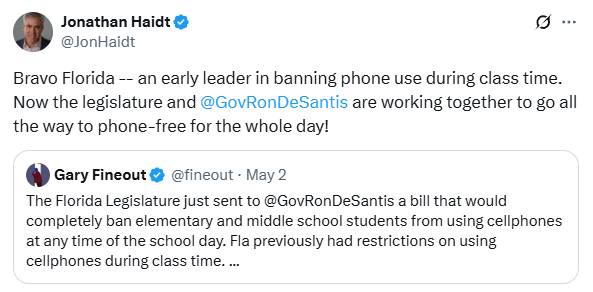
In the final hours of the scheduled session, the legislature sent House Bill 1105, sponsored by Rep. Jennifer Kincart-Jonsson, to Gov. Ron DeSantis. The legislation expands the state’s existing distraction-free learning policy to require that all K-8 schools adopt policies limiting cell phone use throughout the entire school day and pilot the requirement in select high schools with data to be reported to the Department of Education.
Previously, the House passed a requirement that all K-12 public schools adopt policies limiting cell phone use throughout the entire school day, which was the preferred FFF policy. The Senate ultimately favored a more limited policy.
Legislature Approves Education Omnibus Packages
House Bill 1105 included several additional education provisions beyond distraction-free learning, including:
- Requiring the Department of Education to work with the Florida Center for Students with Unique Abilities to develop and implement a workforce credential program for students with Autism. The program must allow students to earn badges that signal the student has acquired specific skills that meet employer needs;
- Requiring that any interlocal agreement that includes additional tax revenue for the public school district must be shared with charter schools;
- Strengthening the charter school conversion process by requiring that a conversion process need only a 50% favorable vote of the parents with students in the school and that a municipality may apply to convert a public school to a job engine charter school, which must offer career education opportunities;
- Allowing students with disabilities who have not earned a high school diploma or reached the age of 22 to remain on scholarship through the Family Empowerment Scholarship for Students with Unique Abilities;
- Expanding private school zoning protections in certain counties;
- Allowing a student who receives an Advanced Placement Capstone designation to be eligible for the Florida Academic Scholarship award under the Florida Bright Futures Scholarship Program;
- Requiring that CTE dual enrollment programs address scheduling changes that impact student participation;
- Allowing charter schools to be eligible recipients under the Workforce Capitalization Incentive Grant program (House Bill 1145 containing this provision previously passed both chambers); and,
- Requiring the Department of Education to develop competencies for the development of a mathematics teaching endorsement.
Both chambers also passed House Bill 1255, sponsored by Rep. Dana Trabulsy, which:
- Requires districts to develop as part of their reading plans:
- A process to deliver intensive reading interventions by personnel who possess a micro-credential in reading or reading endorsement; and,
- A description of how the district will prioritize the assignment of highly effective teachers in grades K-2.
- Eliminates the Florida School for Competitive Academics;
- Expands protections for charter schools to include that:
- A local governing body may not adopt or impose any local building or operational requirements that would impact charter school capacity or hours of operation and adds that no restriction can be placed on a charter school that is not also uniformly imposed on all public schools within its jurisdiction;
- A charter school shall be administratively approved by the local governing authority if it meets the development and construction requirements of state law; and,
- A charter school may not be asked to obtain a special exemption or conditional use approval for the school to be an allowable zoning use.
- Expands private school zoning flexibility and protections in certain counties;
- Requires that costs of postsecondary education must be included in the state’s financial literacy curriculum; and,
- Allows the Department of Education to join or establish an alternative national consortium to develop and implement advanced placement courses.
Revamped Educator Preparation Clears Both Chambers
Rep. Alex Rizo and Sen. Danny Burgess’ House Bill 875, which seeks to overhaul educator preparation in the state, passed both chambers. The legislation will align and standardize the requirements and content of the state’s various teacher preparation programs.
Specifically, the legislation repeals and replaces the existing competency-based certification pathways with a unified state-directed pathway, establishes a new uniform core curricula for all teacher preparation programs and creates the Florida Institute of Teaching Excellence at Miami-Dade College.
Senate Fails to Act on Schools of Hope
The House overwhelmingly passed House Bill 1115 with an amendment from Rep. Demi Busatta, which would have expanded the state’s Schools of Hope charter school program, providing access to vacant, underutilized and surplus public-school property; expanded the definition of a persistently low-performing school; and ensured the money allocated to the program would be fully utilized.
Unfortunately, the Senate failed to take this bill up. There is still an opportunity to consider the legislation in a budget conforming bill, which we hope the legislature will do.